Urban delivery
Douala, B2C, commission per trip
- urban density
- fuel price
- courier cost
- road conditions
- payment methods
- acquisition cost
- retention rate
- courier employment status
An idea can look excellent on paper and still fail once it meets the market. IDEM looks for the factors that can genuinely influence your business, simulates several possible futures, and shows you where your model breaks.
It runs on dozens, sometimes hundreds of factors, and they are never quite the same from one project to the next.
60+
factors typically identified on a single project, before a single scenario is run.
This is not a conversation with an AI. It is a five-stage analysis.
Several agents work in parallel: one reads the project, others research external data, another combines them into scenarios.
1
IDEM builds a structured picture of your project, separating what it knows from what it has to research, what stays uncertain, and what is missing.
2
Agents look for the factors that can actually move this particular business, then rank them as critical, important, secondary or uncertain.
3
Prices, density, costs, regulation, seasonality: every external value arrives with its source, its date and how much confidence it carries.
4
The engine combines factors and runs baseline, favourable and adverse scenarios, stress tests, and rare compound shocks.
5
Viability index, robustness, confidence level, breaking points, the conditions viability depends on, and recommendations ranked by priority.
Two businesses, two worlds. A fixed list of twenty variables applied to everyone would describe neither of them properly.
Douala, B2C, commission per trip
Western Cameroon, short supply chain, B2B
IDEM deliberately puts your business through hard situations, then tells you which ones it cannot take.
Verdict: no-go
When the conditions are genuinely bad, the engine says so, and lists exactly which scenarios the model could not survive.
An index of 72 backed by solid data and an index of 72 riddled with uncertainty do not mean the same thing. IDEM always shows both together.
Simulated viability index
72/ 100
Main uncertainties
This index measures how robust the project is across the scenarios that were run. It is not a prediction of success.
Observed data, a derived estimate and an assumption are not worth the same. Blurring them would give a false impression of precision.
What could make this project succeed or fail, and what should I change?
Not "improve your marketing". Rather: acquisition cost is the model's main weakness, test an organic channel before raising the ad budget. Expected impact high, priority critical, confidence medium.
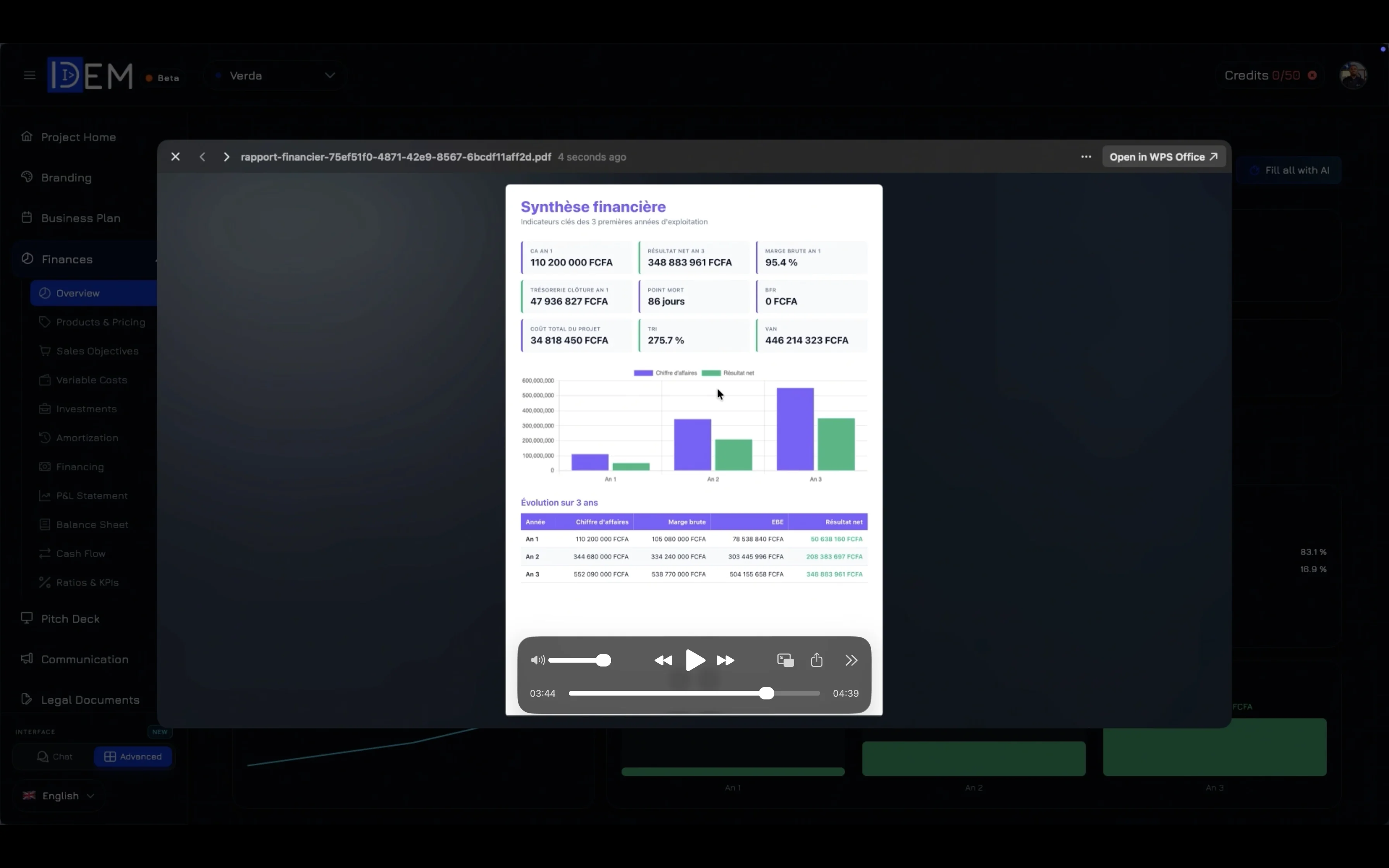
Change your price, your target customer or your funding in IDEM, run it again, and compare the two versions. What moves is not your chance of succeeding: it is how much strain your model takes.
Each new run is kept, so you can compare versions instead of arguing about them.
Business plan, market analysis, financial forecasts and business model are already there. The engine has less to ask for, and you pay less.
Open my dashboardPDF, DOCX or plain text. IDEM extracts the activity, market, target customer, prices and costs, then lets you fill in the gaps before you start.
Import a business planSimulation is billed separately from the rest of IDEM: it spends external research, several agents and compute. The amount is shown and confirmed before anything starts.
The scenarios, the deciding factors, the major risks and the viability index.
The simulation and its full report, cheaper than buying both separately.
The detailed analysis and recommendations, for a simulation you already ran.
The results are estimates based on the data, assumptions and scenarios available at the time of analysis.
A high index guarantees neither viability, nor profitability, nor the long-term survival of your business. A low index does not mean the project is impossible: it means that, in the scenarios that were run, some factors carry significant risk.
It is a decision-support tool. Not a prediction, not a guarantee.
Before you commit your time and your money, find out under what conditions your business can work and what could make it fail.