Africa has the youngest population on earth and the highest rate of people starting a business. What it does not have is tooling priced for it. That is the whole gap IDEM works in.
1,4 Md
Median age nineteen — the youngest population of any continent, heading for 2.5 billion by 2050.
700 M
Growing about ten percent a year, and overwhelmingly on a phone rather than a desktop.
44 M
They account for roughly eighty percent of employment on the continent.
500 M
Africa carries more mobile money traffic than the rest of the world put together.
22 %
The highest rate of new business creation measured anywhere.
5 200
Active across the continent, three times the count of 2020.
Sources: GSMA Mobile Economy Sub-Saharan Africa, ITU, Partech Africa Tech Venture Capital Report, IFC.
None of this is a forecast. Mobile money, the median age and the number of registered small businesses are all measured today.
Products designed desktop-first lose most of the market on the first screen. Everything in IDEM is built to be used from a phone.
More than eight in ten connections are mobile.
A card-only checkout stops most would-be customers before the first screen. Topping up a wallet by Mobile Money does not.
Mobile Money live in thirteen countries, billed in CFA francs.
Sixty percent of the continent is under twenty-five, and the people entering the workforce are the ones creating the businesses.
Around 200 million young people join the workforce by 2035.
When the tool, the hosting and the invoice all sit abroad, every price rise and every policy change lands on the entrepreneur.
Apache 2.0, self-hostable, data exportable at any time.
The problem is rarely the model. It is the price, the currency, the payment rail and the assumption that your customers read English.
Every country has its own grid, built from local purchasing power rather than converted from a single currency.
MTN and Orange Mobile Money top up the wallet, and the wallet pays for what you generate.
French, English and Portuguese today. The deliverables follow the language of your request, not the language of the site.
Financial statements follow the SYSCOHADA chart of accounts, so a loan officer in Abidjan or Douala can read them.
Deploy to managed hosting, to your own VPS, or to a machine in your office. The choice stays yours.
African developers can read the code, fix it and run it. That is what sovereignty means in practice.
Our home market. We know the registry, the tax calendar and the banks because we went through them ourselves.
Cameroon, Gabon, Congo, Chad, Central African Republic
The largest tech market on the continent, and the one where Mobile Money coverage is deepest.
Nigeria, Ghana, Senegal, Côte d'Ivoire, Benin, Togo, Mali, Burkina Faso
The platform works today; what remains is a payment agreement with each operator so you can top up locally.
Kenya, Rwanda, Tanzania, Uganda
The most mature infrastructure on the continent, and the market where we compete head-on with international platforms.
South Africa, Botswana, Namibia, Zambia, Zimbabwe
A region counts as open when you can pay from it. Mobile Money is live in thirteen countries; the rest follow their operators.
IDEM has two co-founders. Both are engineers, both are Cameroonian, and both answer their own email.
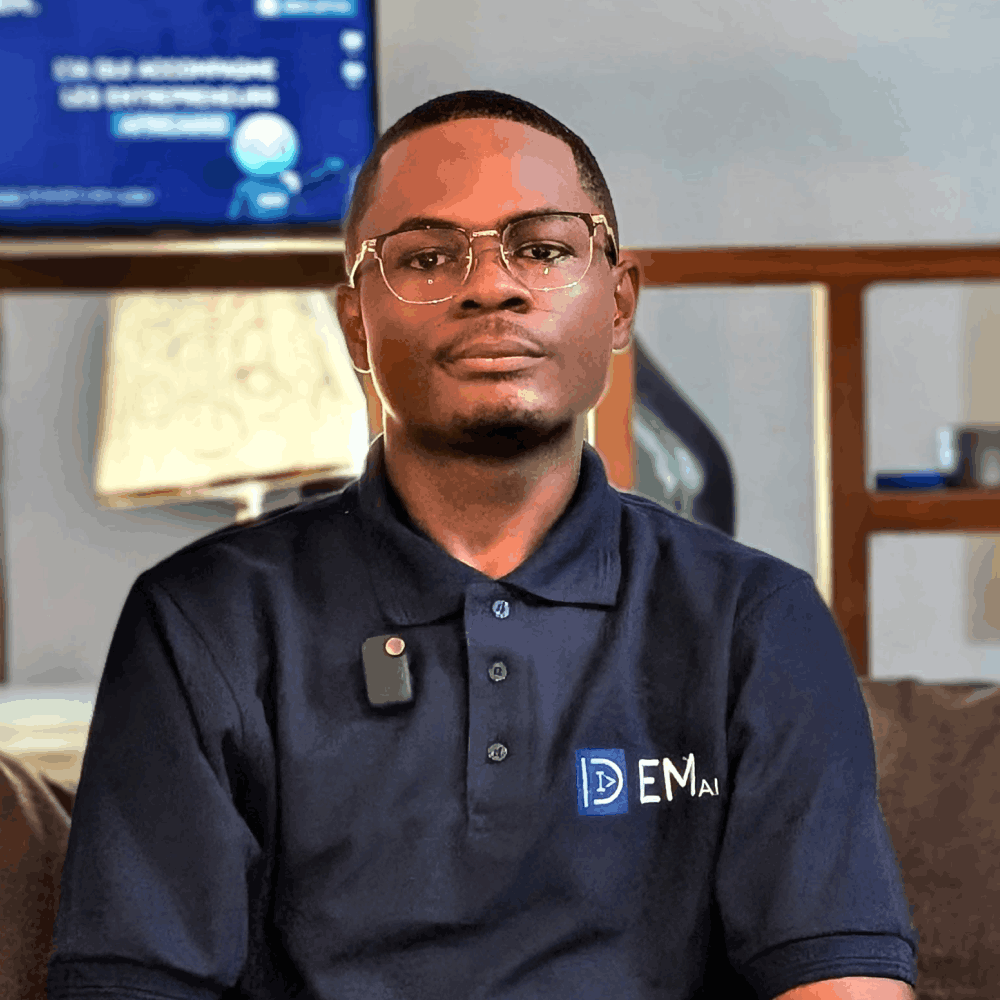
CEO, co-founder
Senior software engineer. He decides what IDEM builds and what it refuses to build, and she knows the African entrepreneurial ecosystem from the inside.

CTO, co-founder
DevSecOps engineer. He owns the infrastructure, the security of the platform and everything that has to keep running when traffic grows.
Describe your business in a few sentences and see the brand, the plan and the site it produces. Nothing to pay to find out.